











Smarter, Deeper, Stronger:
The CliffGuard Approach
Organizations depend on iOS and Android applications for customer engagement, workforce productivity, payments, healthcare, financial services, and critical business processes. Weak authentication, insecure storage, exposed APIs, vulnerable components, and platform misconfigurations can expose sensitive data and increase application risk.
CliffGuard’s Mobile Application Security Testing Services help organizations identify mobile vulnerabilities, validate security controls, test application behavior, assess APIs, and strengthen protection across application code, devices, backend services, and mobile platforms.
Mobile Application Security Testing evaluates iOS and Android applications for vulnerabilities affecting application code, authentication, data storage, network communications, platform interactions, APIs, and runtime behavior.
Testing combines static analysis, dynamic testing, manual security validation, reverse engineering, API testing, and configuration review to identify exploitable weaknesses across the mobile application attack surface.
CliffGuard aligns testing with the OWASP Mobile Application Security Verification Standard (MASVS) and OWASP Mobile Application Security Testing Guide (MASTG) to provide structured, repeatable mobile security validation.

📱 Android & iOS Security Testing – Assess native, hybrid, and cross-platform applications across supported mobile environments.
🔍 Static & Dynamic Analysis – Review binaries, code behavior, permissions, dependencies, memory, files, logs, and runtime activity.
🔐 Identity & Business Logic Testing – Test authentication, authorization, sessions, biometrics, tokens, workflows, and transaction controls.
📂 Storage, Privacy & Cryptography – Assess databases, files, backups, keychains, encryption, sensitive data, and privacy controls.
🔗 API, Network & Platform Testing – Test backend APIs, certificate validation, deep links, IPC, WebViews, and device integrations.
🧩 Reverse Engineering & Resilience – Validate obfuscation, tampering, debugging, hooking, repackaging, root, and jailbreak defenses.
Define the application scope, supported platforms, user roles, test accounts, sensitive workflows, backend APIs, and testing restrictions. Identify application technologies, third-party libraries, permissions, integrations, and security-sensitive functions.
Examine APK or IPA files for hardcoded credentials, insecure configurations, vulnerable libraries, excessive permissions, weak obfuscation, exposed components, and reverse-engineering risks. Review platform-specific security controls and application signing.
Test the application on controlled devices and emulators to evaluate local storage, memory handling, authentication, session management, network traffic, certificate validation, device protections, and resistance to runtime manipulation.
Validate identified weaknesses through controlled exploitation, including authentication bypass, API abuse, insecure data access, privilege escalation, workflow manipulation, and platform-control bypass. Remove false positives and confirm actual business impact.
Deliver validated findings, evidence, proof of concept, risk ratings, and platform-specific remediation guidance. Retest corrected vulnerabilities to confirm that security fixes are effective and no bypasses remain.
🔐 Authentication & Authorization Failures – Identify weak login controls, token abuse, privilege escalation, and unauthorized functionality.
📂 Insecure Data Storage – Detect exposed credentials, personal data, logs, caches, backups, databases, and sensitive files.
🔒 Weak Cryptography – Identify insecure algorithms, poor key handling, hardcoded secrets, and ineffective encryption controls.
🌐 Insecure Communication & APIs – Detect weak TLS, certificate-validation flaws, exposed endpoints, and server-side access-control failures.
📲 Platform Interaction Weaknesses – Identify unsafe permissions, deep links, IPC, WebViews, exported components, and clipboard exposure.
🧩 Code & Dependency Risks – Detect vulnerable libraries, insecure components, embedded secrets, and mobile supply-chain weaknesses.
🛠️ Reverse Engineering & Tampering – Validate repackaging, debugging, hooking, binary modification, root, and jailbreak bypasses.
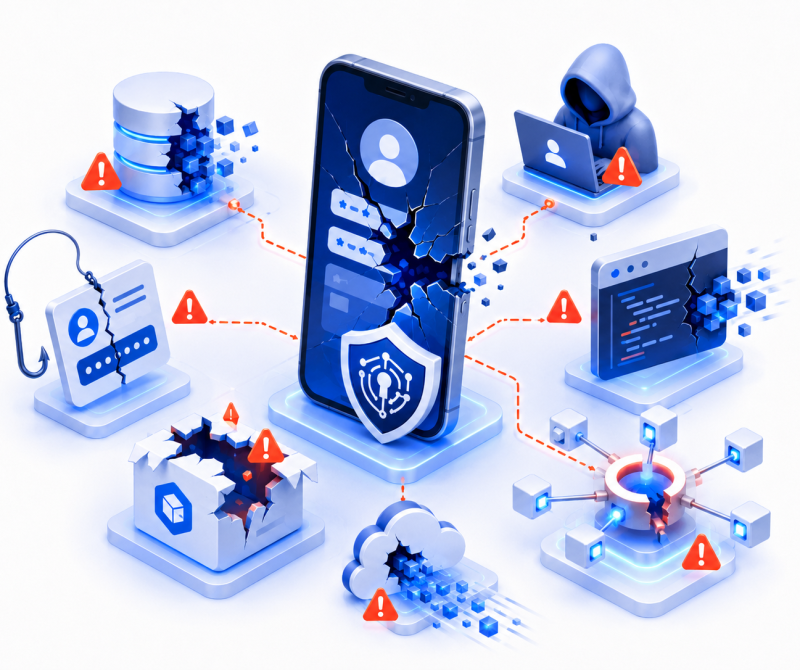

📱 Reduced Mobile Exposure – Identify exploitable weaknesses before attackers compromise applications, users, or backend services.
🔐 Stronger Account Security – Reduce account takeover, token misuse, privilege escalation, and unauthorized access.
📂 Improved Data & Privacy Protection – Protect credentials, personal information, payment data, and sensitive device content.
⚙️ Safer Mobile Transactions – Prevent fraud, workflow manipulation, replay attacks, and unauthorized business actions.
🛡️ Validated Security Controls – Confirm whether encryption, APIs, platform controls, resilience, and privacy protections operate effectively.
Mobile Application Security Testing identifies vulnerabilities across Android and iOS application code, local storage, APIs, authentication, sessions, device interactions, platform controls, network communication, and business workflows.
CliffGuard tests native Android and iOS applications, hybrid applications, cross-platform applications, enterprise mobile apps, and applications developed using modern mobile frameworks.
We identify insecure data storage, weak authentication, broken authorization, API vulnerabilities, hardcoded secrets, weak encryption, unsafe communication, reverse-engineering risks, platform misuse, and business-logic flaws.
Yes. We assess the APIs used by the mobile application for authentication, authorization, data exposure, input validation, session management, rate limiting, transaction security, and business-logic weaknesses.
Where appropriate and authorized, testing may include rooted or jailbroken environments to evaluate runtime protections, anti-tampering controls, root or jailbreak detection, hooking resistance, and application behavior on compromised devices.
The report includes an executive summary, validated findings, severity ratings, affected components, evidence, proof of concept, business impact, reproduction steps, remediation guidance, and post-remediation status.
CliffGuard combines manual-first testing, Android and iOS expertise, reverse engineering, API assessment, business-logic analysis, and practical remediation support to deliver accurate and actionable mobile security assessments.
Mobile application risk cannot be reduced without testing real application behavior, attack paths, and control effectiveness. CliffGuard combines mobile penetration testing, code analysis, API testing, and remediation validation to strengthen application resilience.
Safeguard your mobile applications with manual-first security testing, reverse-engineering analysis, and real-world exploit validation. CliffGuard identifies insecure storage, weak authentication, API flaws, and platform-specific risks early—before attackers compromise users, sensitive data, or business operations.